
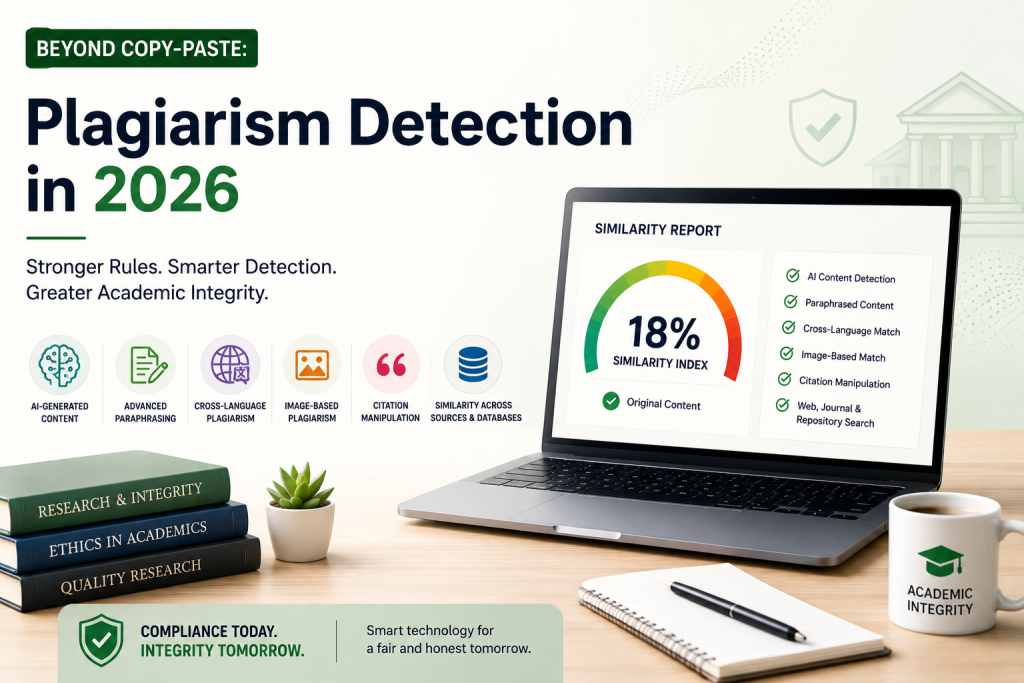
Academic integrity in 2026 is lightyears beyond old-school copy-and-paste plagiarism. While UGC regulations are still the backbone of plagiarism control in Indian Higher Education, today’s institutions face a plethora of challenges such as AI-generated writing, sophisticated paraphrasing, translated plagiarism, citation manipulation and other sophisticated forms of academic misconduct that go beyond traditional similarity detection tools. With institutions seeking more robust and future-ready solutions, attention is turning to Advanced Plagiarism Detection Software capable of identifying subtle patterns of content manipulation while ensuring transparency and fairness in evaluation. In this changing landscape, eAarjav is ready to combine advanced plagiarism detection & AI plagiarism detection to help universities meet UGC requirements while dealing with the reality of modern academic integrity.
Plagiarism control in Indian Higher Education still largely relies on the 2018 regulations issued by the University Grants Commission under the Promotion of Academic Integrity and Prevention of Plagiarism in Higher Educational Institutions framework. The guidelines made it mandatory to screen theses, dissertations and research publications for plagiarism before approval.
The regulations mandate the use of plagiarism detection software, formation of Institutional Academic Integrity Panels (IAIP), and penalty structures based on similarity for academic misconduct.
The UGC framework broadly classifies plagiarism into various levels. In general, a similarity up to 10% is acceptable, 10%–40% usually requires revision, 40%–60% may incur penalties, and similarity over 60% will lead to severe disciplinary action. These regulations laid a strong foundation for academic integrity in India.
But the academic ecosystem in 2026 is very different from what institutions thought it would be in 2018.Today’s AI tools can produce essays, literature reviews, research summaries and even technical papers in seconds. Traditional plagiarism software, which primarily relies on direct text matching, struggles with detecting AI generated or intelligently paraphrased text. This has exposed one of the biggest holes in the current system – there is still no comprehensive, nationwide UGC framework that fully addresses AI-generated academic content and new forms of academic misconduct.
As a result, universities are increasingly looking for Advanced Plagiarism Detection Software to detect AI-generated writing, high level paraphrasing, cross-language plagiarism, image-based plagiarism, citation manipulation and similarities across journals, repositories and web databases.
This is precisely where eAarjav stands out as a future-ready platform for academic integrity. eAarjav is developed to address the changing needs of institutions with a combination of advanced plagiarism detection and AI plagiarism detection to help universities identify sophisticated forms of content manipulation while encouraging transparency, fairness, and responsible academic practices.
Just compliance won’t be enough anymore in 2026. For academic institutions, the need for intelligent, scalable and future-proof plagiarism detection systems is essential to protect academic credibility in an era of AI-driven research. The real question today is not whether plagiarism detection exists but whether the technology is advanced enough to catch the next generation of academic misconduct.