
Research integrity is based on trust — trust that findings are original, data has not been fabricated, and authorship is honest. To combat this, institutions are
turning towards automated tools, such as plagiarism checkers and AI-content detectors. But these tools aren’t perfect, and one of their most
underappreciated risks is the false positive: a situation where original,honest work is wrongly flagged as plagiarised, AI-generated, or fraudulent.
What’s a false positive?
False positive is when a detection system incorrectly labels a valid piece of content as being problematic. This might be a well-cited literature review identified as copied text, a student’s original writing marked as ‘AI-generated’ or standard technical language in a scientific paper misclassified as duplication.In academic and research settings, the risk of such misfires is increased in scientific writing by the reuse of standard terminology, descriptions ofmethodology, and field-specific phrases.
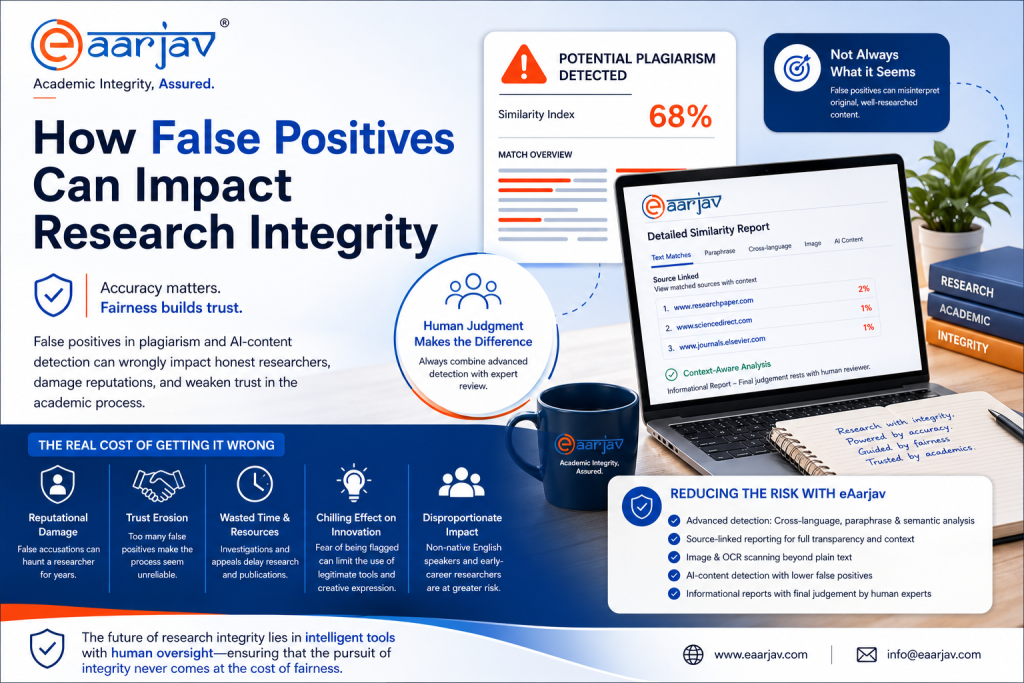
The Real Cost of Getting it Wrong
Reputational
- Damage — False accusations of academic misconduct can haunt a researcher for years, even after the accusation is retracted. Peers, funding bodies
and journals may remember the flag well after they forget the correction. - Trust Erosion in the Process — When false positives occur too often, researchers start to see integrity checks as arbitrary or unreliable, undermining the very system intended to protect them.
- Wasted Time and Resources Investigating and appealing a false charge takes time away from real research, delays publication, and forces academic review boards to deal with unwarranted cases.
- Chilling Effect on Innovation — Researchers may begin to over-sanitize their writing or avoid using AI-assisted tools altogether, even for legitimate
purposes like editing or summarization, out of fear of being flagged. - Disproportionate Impact — Non-native English speakers and early-career researchers are often more vulnerable to false flags, since detection algorithms can misinterpret certain writing patterns as signs of AI generation or plagiarism.
Reducing the Risk
The answer isn’t to throw integrity checks out the window, but to use tools that are accurate, transparent and context-aware — and to always pair automated results with human judgement before jumping to conclusions.
This is where a tool like eAarjav offers real value. As an AI-powered plagiarism and AI-content detection system, its benefits include:
- Reducing blind spots leading to missed/misattributed matches, Cross-language and paraphrase detection
- Source-linked reporting, displaying precisely where a match comes from so that reviewers can assess context rather than a raw similarity score.
- Scanning with image and OCR, going beyond plain text checks to include scanned documents and pictures
- A stated design philosophy that considers its reports as informational, not conclusive proof of misconduct, with the final judgement left to human
reviewers
Conclusion
False positives pose a silent but serious threat to research integrity that can be as damaging to honest researchers as undetected misconduct is to the record itself. The future is not blind faith in automation, but intelligent tools with human oversight, ensuring that the quest for integrity does not come at the
- cost of fairness.