

Detecting plagiarism used to be simple. Early tools merely highlighted exact matches between your text and web pages. Plagiarism tools flagged the content if the wording matched exactly.
Writing has drastically changed in the modern era. AI writing tools, paraphrasing software, and translation tools now allow users to easily rewrite, reorganise, or automatically generate content. As a result, plagiarism now includes paraphrased ideas, translated content, and text generated by artificial intelligence.
Because of this change, sophisticated Plagiarism detectors are now crucial. Modern plagiarism detectors, in contrast to simpler ones, employ new methods to comprehend writing patterns, context, and meaning. They examine the text’s composition and compare it to billions of sources rather than just matching words. This enables them to identify more covert types of plagiarism, like rewritten or paraphrased content, translated material, and text produced by artificial intelligence, in addition to direct copying.

How the Process Works
The procedure is straightforward. The majority of tools let users upload Word, PDF, and plain text documents. Some even incorporate Optical Character Recognition (OCR), which allows for the verification of handwritten assignments or scanned documents. After users upload the document, the system scans it against large databases, which include:
- Books
- Scholarly journals
- Websites
- Research papers
- Publisher archives
AI looks at sentence structure, vocabulary patterns, and overall meaning rather than merely recognising identical phrases. This approach preserves the original idea while identifying content that writers have extensively edited or paraphrased.
Detailed Reports and Source Identification
The tool produces a comprehensive report following the scan. The tool indicates matching sections and connects them to their original sources.
Additionally, trustworthy tools help users identify areas that require attention by differentiating between properly cited references and actual plagiarism.
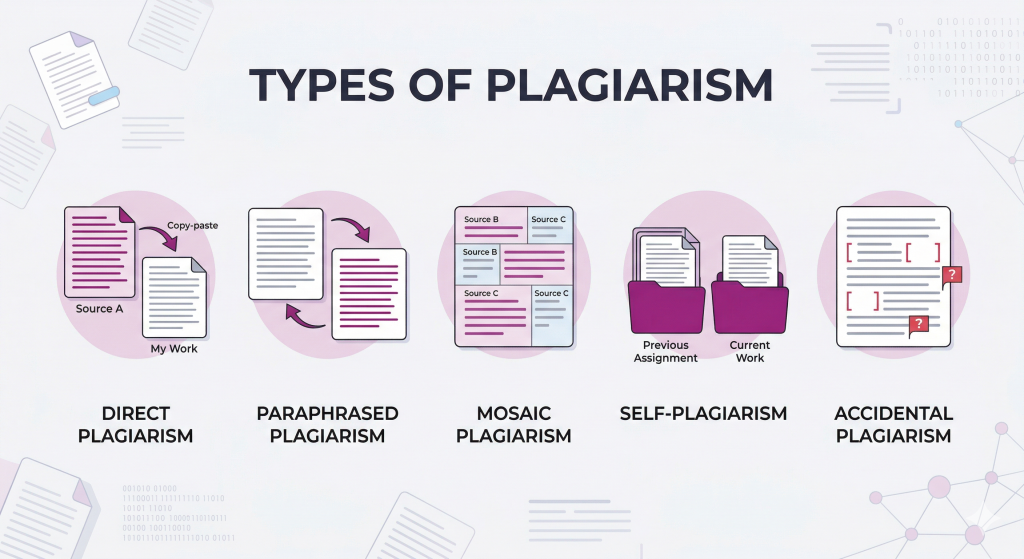
Types of Plagiarism These Tools Can Detect
The tool indicates matching sections and connects them to their original sources. These include:
- Self-plagiarism (reusing your own prior work)
- Mosaic plagiarism (combining phrases from multiple sources)
- Paraphrased plagiarism (rewriting ideas without giving credit)
- Direct plagiarism (copying text word for word)
- Accidental plagiarism (caused by missing citations)
Running a check prior to submission serves as a crucial safety precaution, because unintentional plagiarism is frequent.
Understanding Similarity Scores
The fact that similarity scores don’t provide the whole picture is another important point. When writers properly cite quotes or references, a research paper may show a higher similarity percentage. Sophisticated tools filter out these valid citations and highlight only genuine originality issues.
Who Uses Plagiarism Detection Software?
Students, researchers, educators, content writers, publishers, and companies all use Plagiarism detection software these days. Before publishing or submitting any written work, it is beneficial for all authors to confirm its originality.
Final Thoughts
Ultimately, the goal of plagiarism detection is to keep writing transparent and credible, not to punish. Using a sophisticated plagiarism detector gives you the assurance that your work is genuinely unique in a world where AI tools and a wealth of online information are readily available.